
Lessons From My Dogs: Helping However We Can


The higher goal of all spiritual living is not to amass a wealth of information, but to face sacred moments.

                                                                        --Abraham Heschel


            I’ve never believed that humans were at the top of the evolutionary ladder. I mean, how could we be when we’re the only species that systematically destroys the earth that sustains us? Animals, plants and rocks seem so superior. Just as I’ll look upon a little ant roaming my kitchen and think that he probably isn’t aware of my existence, lost as he is in his immediate world, so different from mine, then might there be larger or different life forms who also look down upon me as I go about equally unaware? The point, I guess, is to think outside the box. To live outside the box. Because we can so easily get caught up in our small, limited worldviews—the seeing the table as solid sort of thing, when it is, in fact, a whirling mass of moving molecules.

            It’s around this theme, that I’d like to offer a story. This past September, while I was eating and drinking my way through Provence, Jodie, a friend of mine, was spending her vacation volunteering at Animal Aid Unlimited in Udaipur, Rajasthan, India. You’d have thought this act of generosity, courage and selflessness would garner admiration from those with whom she worked, in the way it did from me. And yet, often she was met with mistrust at best and scorn at worst. Colleagues questioned the sanctuary and criticized her for spending time and money flying to India to help when there are plenty of animals in need in the U.S. To which I say, true, there are humans and animals who need help in our own country. But help is help, and I don’t think it matters where you volunteer your time or send your money if you feel moved to do so. What matters is that you do it.

            In developing countries there is an intimacy with animals that doesn’t always exist in the U.S. It’s common to have bugs, reptiles and birds in the home. I’ve had a bird fly in through open windows and snatch part of the bread I was eating. In the U.S. we let in certain animals (dog and cats) and try to eradicate others (insects and rodents). There are people in developing countries who care about the plight of sick and wounded animals, but because one is also faced with many sick and wounded humans, people don’t know how to begin helping the animals. Few precedents have been set. They turn a blind eye and then that becomes the way it has always been.

            Like Jodie, I too felt drawn to developing countries in my twenties and thirties, and traveled the globe with the desire to help “save the world.” Once, in Bangladesh, after the devastating cyclones of 1991 that killed many thousands of people and animals, I flew to that desperately poor country, seeking to connect with the Red Cross or other organization and put myself to use. While I was able to hand out fresh water, rice and bread, I didn’t save the world. I saved one goat. And, no different from my friend in India, was met with varying degrees of: Are you crazy or Are you stupid? Flying all the way to Bangladesh to save one goat? But, like the boy and the starfish story, to that goat, my time wasn’t wasted. To that one goat, it was everything. I have another friend who rushed off to Venezuela to help feed the animals, after hearing about the country’s economic crisis. So, whether Bangladesh, India, Syria, Venezuela, the U.S., or elsewhere, we help wherever we can. We help however we can.

            And with this thought in mind, off Jodie flew to India, arriving some twenty-two hours later, an ordeal in itself not for the light-hearted. At the Animal Aid sanctuary, she sat with dying cows, wetting their lips with water and speaking softly into sacred ears. She worked with the paralyzed and legless dogs, who she reported were active and just as happy (if not more so) than dogs we encounter at home. If the videos she sent, and those from the website, are anything to go by, those dogs are 100 % bounding joy. I’ve seen this phenomenon before. Dogs in first world countries can become neurotic or depressed, taking on their guardians first world problems and anxieties, where dogs in the developing world are, in some ways, healthier. They may die at earlier ages from mange and diseases we see as easily preventable, but being allowed to be dogs, and outdoors, they’re happy, roaming the streets, doing what dogs love to do, not cooped up in apartments, lonely, with one hour outside. Even in some of our finest shelters, dogs are kept in separate runs, under conditions that would break the brightest of spirits. In India, the dogs were all outdoors and all together in one big, happy, rambling pack. My point is not to criticize the hardworking people in our shelters. They’re helping however they can. My point is to get us all to think outside the box, and see that maybe our way is not always the only way. And that animals on the streets (if spayed and neutered and given basic care) can also be happy animals. And that that might in fact be their choice.

            And so along those lines, I come to the story that Jodie told me happened while she was there.

            When not volunteering, she stayed in a guest house about a half hour away from the sanctuary. One night, well after midnight, she was awakened by the plaintive, mournful sound of a dog howling. It was not a woooh wooooh every so often and it was not a hello howl to the moon. It was instead, incessant and urgent. It was seemingly inconsolable and deeply troubling. My friend rose, and walked to the window, where, sure enough, there was a female dog lying in the road howling for all she was worth.

            What to do now? One couldn’t just leave her down there in trouble, possibly in considerable pain. (One couldn’t sleep for one thing.) But the dogs who roamed the streets were not tame. These were feral dogs. She could be diseased. She could be injured, in which case she might attack and bite. Back and forth my friend waffled, trying to come up with the best answer for this dog in distress. And all the while she waffled, the dog in the street wailed, louder and louder, and more insistently with each howl.

Until she was answered.

            Jodie stepped out onto the balcony and listened. Slowly, but steadily, as the dog in the street howled, she was answered…one by one…by distant voices. She howled and would receive an answer from a different quadrant. And then my friend watched, awed, as one after another, the pack members returned to what appeared to be the Alpha female, each one settling in by her side, and lying down. And after the last member of the pack was assembled, secure by her side, the female lay her head down, perfectly content now that her pack was all back together.

            Jodie tried to explain the effect and the sense of family that the incidence had on her, but like most events that move us deeply, touching us at our cores, words can only paint on a one-dimensional canvas. The stories that are most meaningful are also those that often remain untold. Jodie could have played the hero and rushed up, in a display of ego, to “help” this female in distress. But some part of her intuition or wisdom caused her to pause, to not react. Instead she stood and watched. Instead she stood and listened to the particular music of an Indian night, but also to the great wisdom that resides within us all. And her reward was the miraculous and heartwarming event she witnessed. Or what to lowly humans can seem miraculous, when to the rest of the animal kingdom, it’s just how things are. A great interconnectedness, and mutual respect for one another. Here, the animals are our wise teachers, if we only just stop and listen to them.

The dogs may be deformed and broken but the sanctuary overflows with love and compassion.
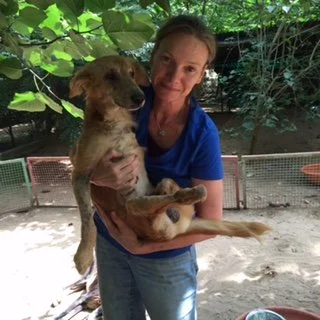
 

Jodie and Deepok.

To find out more about Animal Aid Unlimited or to make a donation: www.animalaidunlimited.org.

Lessons From My Dogs: The Stamp of Love


Si on me presse de dire pourquoy je l’aymois, je sens que cela ne se peut exprimer, qu’en respondant: Par ce que c’estoit luy; par ce que c’estoit moy. If I were pressed to say why I love him, I feel that my only reply could be: Because it was he. Because it was I.

                                    —Michel de Montaigne, explaining why he loved his friend.


Ice covers the branches and now hangs, frozen in falling, in solid crystal droplets like winter’s perfect pearls—and I have never seen anything so pure, a feeling I know I’ll try to express again with the first buds of spring and again in sacred autumn, but for which in truth I know I have no words. For now, I stand enchanted in a silence broken only by the cawing of a crow, as she flies across a heavy quilt of gray, and the slight ticking of ice as the birds hop from silvered branch to frozen ground and back to branch again.

Recently I was listening to a program on NPR about great art. The curator said, “Everything has a price,” even the Mona Lisa now behind her protective pane of glass within the Louvre’s hallowed walls. The Mona Lisa? Really? Well, perhaps in the art world everything does have a price. But there remain ‘things’ for which one can never assign monetary value. While I know it happens in difficult circumstances, I think few parents would willingly sell their children.

          I remember the old Master Card commercials that listed several glamorous material objects—sports car, exotic vacation, gemstones—each with impressive price tags. Then the ad mentioned something priceless: being there to see your child score his or her first homerun. Now, as I stand surrounded by nature’s mystery, present to a vastness and beauty that knows no logic—only awe—I know the moment has no price. It just is.

          As I sat in my meditation chair, Lauren’s old chair, Sasha stared up at me, a round butterball turkey masquerading as a dog. Then she leapt. There is nothing subtle about Sasha. But where subtly falls short, love and loyalty make up for it. She squished up atop my lap, throwing back her head and staring up into my eyes just as Lauren used to do. Then she settled into the spot where she loves to sit, between my legs on a small 8 x 8 cushion, which was a beautiful and unexpected gift my seamstress made for me out of the old fabric of this beloved chair when, threadbare and duck-taped together, it had to be reupholstered. While Sasha is the least introspective of my three dogs, the cushion has become her meditation pillow. I remembered back to when Sasha first entered our lives, bringing the great depression, as I called it—a period of unease due to her own deeply depressed feelings—disrupting the peaceful life of joy that Flash and Chance and I shared. But there in the chair, as I stroked her, I told her: “Sasha, I’d not give you up, even for ten million dollars.” They were the same words I’d used back then so long ago to reassure her that I would not forsake her, and as I spoke the words again, I knew their truth. There is no price tag for them. For love.

          While I know I don’t “own” the dogs—they are not mine, they are my responsibility and they are…priceless. I read that if we can lose something in a shipwreck, it isn’t ours. Of course, we can lose our bodies, our selves, so perhaps, when we speak truly, we own nothing.

          With the dogs I share a partnership based not so much on an alpha hierarchy as on mutuality—listening to what they have to say and taking an interest in their world. For Olive this means sharing her enthusiasm (or perhaps indignation) over the squirrel who steals the birds’ seed. I put out more than enough for him too since the acorn crop this year was slim to nonexistent.

          “Do you want to get the squirrel?” I ask in my most squirrel-animated voice, hoping of course that she never really will, and she pricks her ears and comes running. I open the gate and let her root around in the compost pile at the base of an old walnut tree where the squirrels hang out.

          Taking an interest in Chance’s world simply means being home, being there. Once so independent, she now follows me from room to room, her deaf ears forcing her to search with nose and sight more than she once did for the comfort and reassurance she seeks in knowing I’m here. I’m impressed by how well she and most animals adapt to the loss of a sense, but sometimes I see confusion shadow her white face. I want to put to words the love my fingers know, deep to the bone, every time they caress the lumps and bumps that now cover her fragile frame. I want to put to words the pang I feel when I turn and see her lagging so far behind on our walks when once she strode out front, or when I watch her try to jump upon a chair and fall. I want to put to words the feeling that builds within me as I stand and watch her sleep—but I can’t. I love her more than I have words to say. Every time I see her walk the wrong way in her search to find me and stare off to an empty room with pricked ears, she is writing her own story upon my breast—engraving grooves of sorrow on my heart from which I’ve learned not to turn for, when I stand in stillness and listen to the wisdom of the wind, I understand these are the same grooves as those of joy.

Sasha, Chance, and Olive in the spring air.

          Because of her there is now the daily puddle of urine on the rug or even in the bed. I don’t want a house that smells of dog pee…but neither, I realize, do I want its end. And when we love unconditionally, we forgive everything. We don’t judge, but merely observe and accept. In real love, familiarity does not breed contempt but rather a bond so connected that we feels its desolation if severed.

True love wears no price tag. It just is. And yet people would pay millions to have it. The dogs with whom I share my life don’t leave behind their marks in poetry or song; they’ve never painted a picture, let alone the Mona Lisa, but they leave behind their mark in other ways. They stamp it on my heart.


Lessons from my dogs: Time regained


When we have passed a certain age, the soul of the child we were and the souls of the dead from whom we have sprung, come to lavish on us their riches and their spell.

                        —Proust, Time Regained


Fall, summer’s shadow, hints at winter. I hear the screech of the hawk gliding high above the treetops and the crows cawing back and forth to each other in a language I am only beginning to understand. Fields of lingering gold: Jerusalem artichoke and goldenrod mingle with iron weed and poke. Fall might mean death and decay to some, but I rejoice in the lessening of humidity, the shortened days and clear, pure nights.

When we travel to foreign lands and step out into new and different air for the first time, it exhilarates. The first morning of cool, crisp air of autumn is like that for me, transporting me to another place and time, which is no more than the changing season.

Like in spring, the animals are again on the move: turtles, insects, mammals, migrating birds—their patterns shifted from the lazy, abundant summer. Each year I see fewer and fewer turtles, toads, butterflies, and other insects but this year the decline was dramatic. I feel the loss and wonder if the world will, too.

Far out in the fields, Sparkle and Stash speak following the scent of roaming rodents. Perhaps they smell the two little fawns that with their fading spots have taken up residence. Their mother was killed and now I watch them, bonded together and playful, zipping around, yet wary. They graze on tall grass then snap heads up, forever watching. Every time they zig and zag closer to the road, my heart flutters.

The resident snakes have vanished, yet bittersweet wraps itself around tree limbs in imitation, and the smell of burning leaves permeates still air.  Russet leaves rattle and fall. The light changes. In the dusk of evening there’s a golden glow. Nights are dramatic: windswept and starry. A half-moon darts across the sky, carried by moving clouds.

Soon, All Hallows’ Eve. I remember the Halloweens of childhood. To this day I still watch Charlie Brown’s Great Pumpkin, and feel the warmth of childhood, the smell of bread baking and meals cooking. It’s said that the veil between the living and the dead is most thin on Halloween or All Saint’s.

I think of the dogs who’ve gone on, the past tense already claiming them when I write. I try to connect and sometimes it’s enough just to focus and remember. But other times, they come to me like ghosts in a dream, surrounding me, ducking and dodging in and out of my consciousness, playful and light, yet constant and eternal. And I realize they never leave us, not really. We’re connected—connected through love.

            All of them—the ones here in flesh and those now no more than memories—visit when I summon, as I look deep into their eyes in a faded photo. And all teach me something of how to live this life more fully and care for the dogs here now with more presence, and for all beings, all of life. They’re all unanimous in saying: be present, take nothing in life for granted, live simply, love simply, simply love.

            In deep and reverent presence, time slows, and time is regained.

The two little fawns, alert and wary, yet growing used to my presence.